How Much Do Managed IT Services Cost in Chicago?
A Pricing Guide for Small and Midsized Businesses
By Adam Barney, President of Framework IT | Last Updated: April 2026
Most Chicago businesses we talk to are surprised to learn that comprehensive managed IT services cost less per year than a single full-time IT hire. After consulting over 1,000 companies on their technology strategy, I can tell you the pricing question isn't complicated once you understand the models. But most of the information out there is vague on purpose, because it's written by providers who don't want you to compare.
It's a fair question. And the honest answer is: it depends. Not because providers are being evasive, but because managed IT services aren't a single product. They're a combination of support, strategy, and security tailored to how your organization operates. The variables that drive pricing are real, and understanding them puts you in a much stronger position to evaluate proposals.
This guide breaks down the most common pricing models, what drives costs up or down, and what you should actually expect to pay for comprehensive managed IT services in the Chicago area. No sales pitch. Just the information you need to make a confident decision.
What Are the Most Common MSP Pricing Models?
A Managed Services Provider (MSP) is a company that manages a business's IT infrastructure, support, security, and strategic planning under a predictable monthly contract. MSPs generally structure their pricing in 1 of 3 ways. Each model has trade-offs, and the right one for your business depends on how you want to budget and what level of service you need.
Per-User Pricing
The most common model for small and midsized businesses. You pay a flat monthly fee for each employee (or technology user) in your organization. The fee covers all the IT services included in your plan, regardless of how many devices each person uses.
I've reviewed hundreds of MSP proposals over 15 years, and the gap between a $100/user plan and a $250/user plan is almost always about scope, not quality of support. The lower-priced plans typically strip out cybersecurity, strategic consulting, or onsite support. Those aren't optional line items. They're the difference between a partner that keeps your business running and a help desk that picks up the phone.
Per-Device Pricing
You pay based on the number of devices (laptops, desktops, servers, network equipment) being managed. Less common for small businesses but still used by some providers.
Tiered or Bundled Pricing
Some providers offer fixed tiers (e.g., Basic, Standard, Premium) with predefined service bundles. You pick a tier based on the level of coverage your organization needs.
What Should Comprehensive Managed IT Services Include?
Before you compare prices, you need to understand what you're comparing. A proposal that looks inexpensive on paper may be missing entire categories of service that you'll end up paying for separately, or worse, going without.
Comprehensive managed IT services for a small or midsized business should cover 3 pillars:
IT Support
IT Strategy
Cybersecurity
If a proposal is missing any of these pillars, it's not comprehensive managed services. It's a support contract with gaps, and those gaps are where your risk lives.
How Much Does Managed IT Cost Per User?
For comprehensive managed IT services that include all 3 pillars (support, strategy, and cybersecurity), expect to pay between $150 and $250 per user per month from a mature, operationally established provider.
That range assumes:
Why does the range vary? Two primary factors drive where you land within that range: the number of users in your organization and the current state of your technology environment. An organization with well-maintained, standardized technology will typically fall toward the lower end. An organization with aging equipment, inconsistent configurations, or security gaps will start higher because there's more risk and more work required to support it.
The encouraging part: with the right MSP, your costs should decrease over time as your environment improves. Providers who operate with a best-practice framework will build a roadmap to close gaps, and as you implement those improvements, your support needs drop and your pricing should reflect that.
A note on these figures: the pricing ranges in this guide are based on Framework IT's direct experience consulting over 1,000 companies on managed IT services, combined with publicly available industry benchmarking data from Service Leadership and ConnectWise. Actual pricing varies by provider, geography, and scope of service. These numbers reflect the Chicago market for comprehensive managed services as of early 2026.
If you see pricing significantly below $150 per user, ask what's missing. In most cases, you'll find that strategic consulting, cybersecurity, or onsite support has been stripped out. Those aren't optional extras. They're the difference between a provider that keeps you running today and one that positions your business to grow.
Is $100 Per User Per Month Too Cheap for Managed IT Services?
In most cases, yes. A $100/user price point rarely covers all 3 pillars of comprehensive managed services: support, strategy, and cybersecurity. At that rate, providers are typically offering basic help desk and monitoring only, leaving out critical services like a dedicated virtual Chief Information Officer (vCIO), Endpoint Detection and Response (EDR), Security Operations Center (SOC) monitoring, and strategic business reviews. The result is an IT support contract with significant gaps, not a managed services partnership. If you're comparing proposals and one is substantially below $150/user, ask for a line-by-line breakdown of what's included and what costs extra.
Why Do Most Managed IT Services Providers Have Monthly Minimums?
Most managed services providers have a minimum monthly commitment, typically between $2,000 and $3,000 per month. This can surprise smaller organizations that multiply a per-user rate by their headcount and arrive at a lower number.
The reason is straightforward: comprehensive managed services require fixed delivery costs that exist regardless of your team size. These include:
A 10-person company needs the same strategic planning process, the same cybersecurity stack, and the same account management structure as a 50-person company. The effort doesn't scale down proportionally, which is why minimums exist.
This is actually a useful filter. If a provider doesn't have a minimum, ask how they're delivering strategy and security profitably at that price point. The answer often reveals what's been cut.
What Does a $3,000 Per Month Minimum Actually Get You?
A $3,000/month minimum from a comprehensive MSP typically covers the full 3-pillar stack: unlimited remote and onsite IT support across your team, a dedicated vCIO who leads strategic technology planning and quarterly business reviews, a complete cybersecurity suite including EDR, MDR, SOC monitoring, email security, and staff awareness training, plus proactive monitoring and maintenance of your entire environment. Think of it as hiring a full IT department with specialists across help desk, security, strategy, and engineering for a fraction of the cost of building that team internally.
What Are the Hidden Costs of Managed IT Services?
When comparing MSP proposals, watch for costs that don't appear in the headline monthly fee:
In the Chicago market specifically, some of these costs vary based on local factors: commercial real estate costs affect onsite support pricing, and the concentration of financial services and professional services firms in the Loop and surrounding suburbs creates high demand for compliance-focused IT — which can affect project pricing for security-related work.
Onboarding Fees
Most providers charge a one-time onboarding fee to document your environment, set up monitoring tools, deploy security, and transition service from your current provider. This is standard and reasonable. Expect $2,000-$10,000 depending on complexity. Be cautious of providers who waive onboarding entirely; proper onboarding takes real effort, and skipping it leads to problems.
Project Work
Monthly managed services cover day-to-day support and maintenance. Larger initiatives (office moves, infrastructure upgrades, cloud migrations, new software deployments) are typically scoped and quoted separately. Ask how project quoting works and whether you'll see a fixed-fee quote before work begins.
Out-of-Scope Items
Every managed services agreement defines what's in scope. Common exclusions include support for personal devices, non-standard software, or hardware procurement. Read the scope carefully and ask about anything that's ambiguous.
Licensing and Software
Some providers bundle Microsoft 365 licensing, security tools, and backup software into the monthly fee. Others pass these through as separate line items. Neither approach is wrong, but you need to know which model you're looking at when comparing proposals.
Contract Structure
Pay attention to contract length, auto-renewal terms, and termination provisions. Multi-year contracts are not inherently a problem — they can work in your favor when paired with strong guarantees like service-level agreements (SLAs), satisfaction commitments, and clearly defined exit terms. The concern is when a provider locks you into a long-term deal without offering meaningful performance accountability in return.
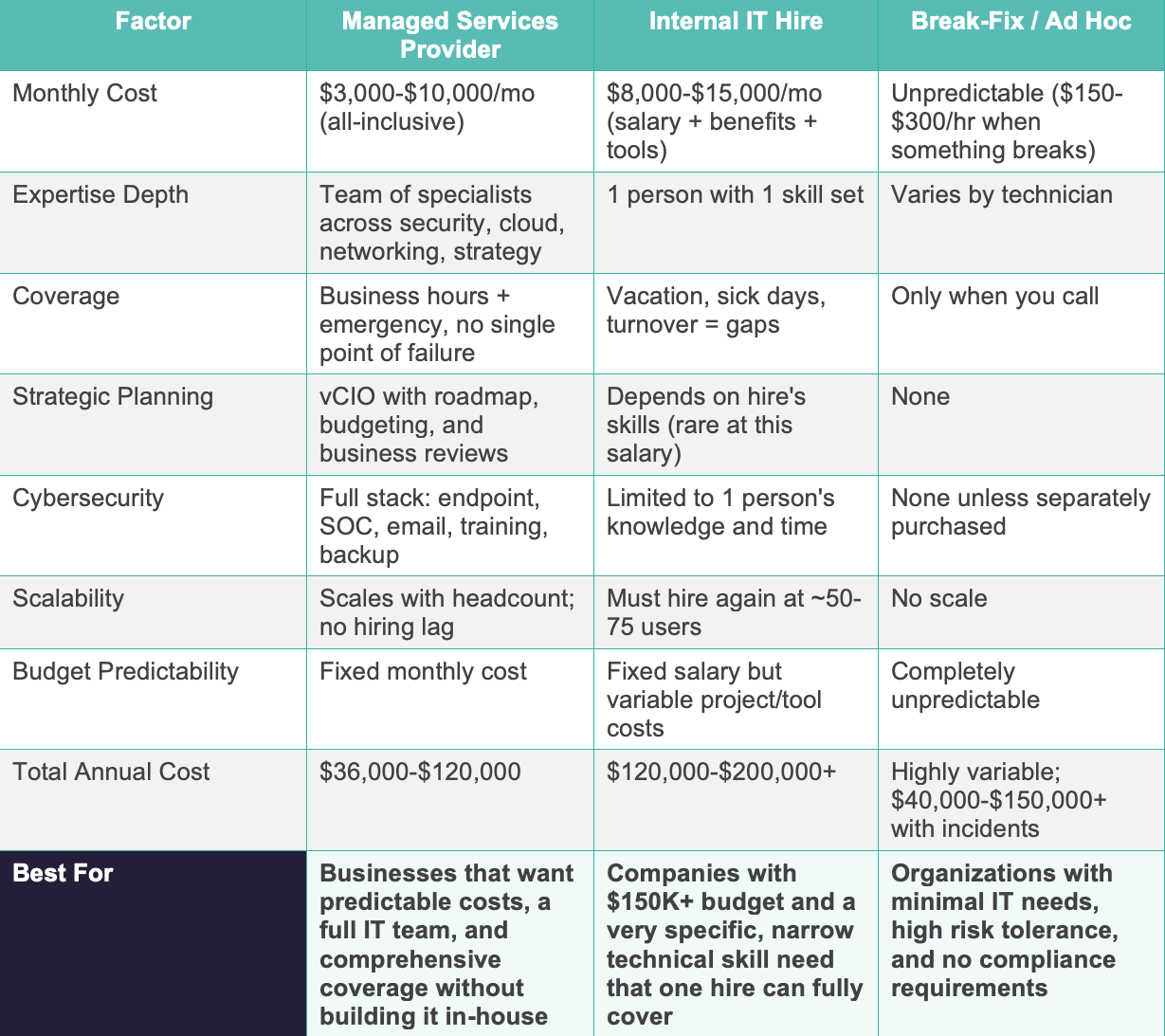
The internal hire comparison is worth examining closely, because it's the question we hear the most. I've watched companies invest $150,000 in an internal IT person and still call us 6 months later because that person couldn't keep up with security, strategy, help desk, and network management at the same time. It's not a talent problem. It's a math problem. An IT generalist capable of handling day-to-day support costs $80,000-$120,000 in salary alone. Add benefits (30-40%), tools and licensing ($15,000-$30,000/year), training ($3,000-$5,000/year), and the fact that one person can't cover security, strategy, networking, and help desk simultaneously, and the true total cost of ownership lands between $120,000 and $200,000 annually for a single employee.
Break-fix sounds cheap until you calculate what an outage actually costs. For businesses with 20-100 employees, downtime costs can exceed $100,000 per hour when you factor in lost productivity, missed deadlines, and reputational impact. The reactive model also means you're paying emergency rates when problems hit, with no one working to prevent them.
How Do You Evaluate MSP Pricing Beyond the Monthly Number?
The lowest proposal is rarely the best value. When you're comparing managed IT services proposals, focus on these factors beyond the monthly fee:
For a detailed framework to compare providers side by side, see our IT Services Provider Comparison Chart and How to Choose a Managed IT Services Provider