Artificial intelligence is rapidly changing how businesses operate.
Employees are using tools like ChatGPT, Claude, Gemini, and Microsoft Copilot
to write emails, summarize meetings, analyze data, create marketing content,
and automate repetitive work.
There's just one problem.
Most organizations have no idea how much AI their employees are already
using.
This growing issue is called Shadow AI, and it's quickly becoming
one of the biggest hidden cybersecurity and compliance risks facing businesses
today.
At Framework IT, we're seeing organizations across
legal, financial, consulting, and professional services industries struggling
to balance AI productivity gains with security, compliance, and governance
concerns.
The reality is simple:
Your employees are probably already using AI tools—whether your
organization has approved them or not.
What Is Shadow AI?
Shadow AI refers to employees using artificial intelligence tools without
formal approval, governance, oversight, or security controls from IT
leadership.
Examples include:
- Copying client information into
ChatGPT
- Using free AI tools to summarize
financial reports
- Generating contracts or legal
drafts with consumer AI platforms
- Uploading confidential
spreadsheets into AI-powered analytics tools
- Using AI note-taking apps during
internal or client meetings
Most employees are not trying to create risk.
They're simply trying to work faster and more efficiently.
But without proper governance, those productivity gains can come with
serious consequences.

Why Shadow AI Is Becoming a Major Business Risk
AI tools are incredibly powerful—but many organizations are adopting them
faster than they can govern them.
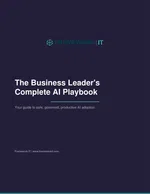
According to research referenced in The Business Leader's Complete AI
Playbook, 75% of organizations already have employees using AI without
formal approval or oversight.
That creates several major concerns.
1. Sensitive Data Exposure
When employees paste information into public AI tools, that data may:
- Be stored externally
- Be processed by third-party
vendors
- Potentially be used to train
future AI models
- Fall outside your organization's
compliance controls
For industries like law, finance, accounting, and consulting, this
creates significant confidentiality and compliance risks.
2. Compliance and Regulatory Problems
Many organizations now face increasing scrutiny around:
- Data privacy
- AI governance
- Auditability
- Cybersecurity controls
If your business cannot explain:
- Which AI tools employees are
using
- What data is being entered
- How AI usage is governed
…you may already have a compliance gap.
This is becoming especially important for:
- Law firms
- Financial services firms
- Healthcare organizations
- Professional services businesses
3. Inaccurate or Unverified AI Output
AI can be incredibly helpful—but it can also be confidently wrong.
Employees using AI without training or review processes may unknowingly:
- Share inaccurate information
- Create flawed financial analysis
- Generate incorrect legal content
- Introduce operational errors
This is why governance and human review remain essential.
Why Employees Use Shadow AI
The answer is simple:
Because AI saves time.
Employees are using AI to:
- Draft emails
- Summarize meetings
- Create proposals
- Analyze spreadsheets
- Build marketing content
- Conduct research
- Automate repetitive tasks
In many cases, AI can save hours every week.
The problem isn't AI itself.
The problem is unmanaged AI adoption.
The Businesses That Will Win with AI
The organizations gaining the most value from AI are not banning it.
They are governing it.
Successful businesses are implementing:
- AI acceptable use policies
- Approved AI platforms
- Security controls
- Role-based permissions
- Employee training
- AI governance frameworks
This allows employees to benefit from AI productivity while reducing
unnecessary business risk.
How Businesses Can Reduce Shadow AI Risk
Create an AI Governance Policy
Organizations need clear guidelines around:
- Approved AI tools
- Prohibited data types
- Acceptable use cases
- Human review requirements
Without a written policy, AI adoption becomes chaotic.
Use Secure, Governed AI Platforms
Consumer AI tools were not designed for enterprise governance.
Businesses should prioritize:
- Zero-data-training guarantees
- Audit logging
- Access controls
- Secure integrations
- Compliance support
Train Employees Properly
Most employees are not trying to violate security policies.
They simply don't understand the risks.
AI training should include:
- Data handling best practices
- Prompting guidelines
- Compliance requirements
- Verification procedures
- Human review standards
Build AI Adoption Strategically
The most successful organizations follow a structured AI adoption roadmap
rather than allowing uncontrolled experimentation.
At Framework IT, we recommend a phased approach that balances:
- Productivity
- Security
- Governance
- Long-term scalability
AI Is Not Going Away
The businesses that wait too long to address AI governance will
eventually face:
- Increased compliance exposure
- Security risks
- Operational inconsistency
- Competitive disadvantages
AI is already reshaping how professional services firms operate.
The question is no longer whether your employees are using AI.
The question is whether your organization is governing it properly.
How Framework IT Helps Businesses Govern AI Safely
At Framework IT, we help organizations adopt AI
safely, strategically, and securely through:
- AI governance consulting
- Managed AI services
- Cybersecurity support
- AI policy development
- AI risk assessments
- Workflow automation guidance
Our goal is simple:
Help businesses capture the productivity benefits of AI without creating
unnecessary operational or security risk.
Download the Free AI Playbook
Want to learn how to implement AI safely inside your organization?
Download our free report:
📘 The Business Leader's Complete AI Playbook
Inside, you'll discover:
- How businesses are using AI
productively
- The risks of unmanaged AI
adoption
- Governance and compliance best
practices
- A practical roadmap for AI implementation